

When looking to improve core strength, enhance flexibility, and reduce daily stress, two low-impact exercise modalities consistently dominate the conversation: yoga and Pilates. At a glance, they look remarkably similar. Both practices often take place on a mat, place a significant emphasis on breathing, and utilize bodyweight resistance to build a lean, toned physique.
However, beneath these surface similarities lie two distinct philosophies, histories, and mechanical approaches to movement. Choosing between them requires an understanding of how each practice affects the body and mind, as well as how their specific training methodologies align with your personal health goals.
Understanding the Foundations of Yoga
Yoga is an ancient spiritual and physical discipline with roots tracing back thousands of years to ancient India. Originally designed as a holistic framework to prepare the body for extended periods of meditation, traditional yoga is deeply rooted in uniting the mind, body, and spirit.
In a modern fitness context, yoga is typically practiced through a series of physical postures called asanas. These postures are combined with deliberate breathing techniques, known as pranayama, and elements of mindfulness or meditation. The physical goal of yoga is often to create space in the body, release accumulated tension, and improve active flexibility and joint mobility.
Because yoga has evolved over millennia, it encompasses a vast array of styles, each catering to different physical capabilities and mental preferences.
-
Hatha Yoga: A slower-paced style that focuses on static holds, alignment, and basic postures, making it ideal for beginners.
-
Vinyasa Yoga: A dynamic style where movement is fluidly synchronized with the breath, flowing smoothly from one pose to the next to build cardiovascular endurance.
-
Ashtanga Yoga: A rigorous, highly structured practice that follows a specific, unchanging sequence of advanced postures.
-
Yin Yoga: A meditative, passive practice where floor-based poses are held for several minutes at a time to target deep connective tissues like fascia and ligaments.
Understanding the Foundations of Pilates
Unlike the ancient evolutionary history of yoga, Pilates is a relatively modern invention. Developed in the early twentieth century by a German physical trainer named Joseph Pilates, the system was originally termed Contrology. Joseph Pilates engineered the program as a rehabilitation method for injured athletes and dancers, as well as a training regimen for soldiers during World War I.
The primary objective of Pilates is to achieve precise physical control over every movement. It operates on a set of fundamental principles, including concentration, control, centering, precision, fluid movement, and breath. Rather than seeking a spiritual connection, Pilates focuses intensely on the physical mechanics of the body, specifically targeting the deep structural muscles of the abdomen, lower back, hips, and glutes. In Pilates terminology, this anatomical core region is referred to as the powerhouse.
Pilates is generally divided into two main delivery styles based on the environment and tools used.
-
Mat Pilates: A sequence of exercises performed on a padded floor mat using body weight and gravity as resistance. It emphasizes precise spinal alignment and deep abdominal engagement.
-
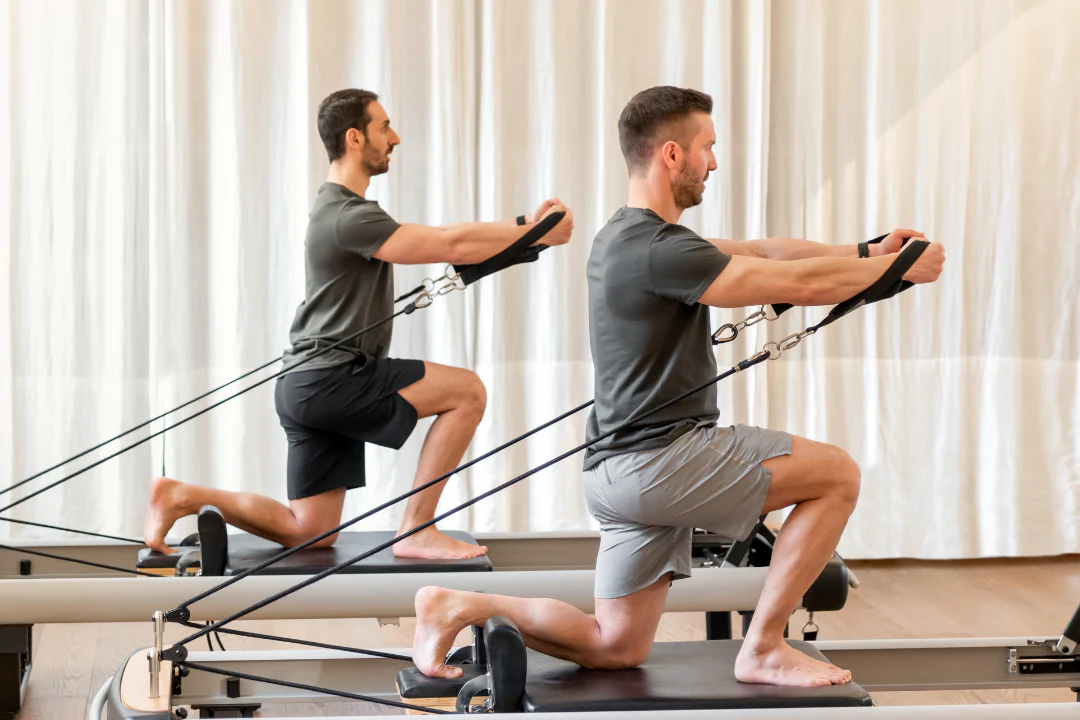
Reformer Pilates: A practice utilizing specialized machinery, most notably the Pilates Reformer, which features a sliding carriage connected to springs and pulleys. This apparatus provides customizable resistance and assistance, allowing for targeted muscle activation and low-impact joint loading.
The Mechanical Differences: How Movement and Breath Differ
To truly understand how these practices diverge, one must look at how movements are executed and how the breath is utilized in a typical session.
Static Holds vs. Controlled Repetitions
Yoga frequently involves moving into a specific posture and holding it for several breaths. The physical challenge comes from resisting gravity, maintaining balance, and consciously relaxing into a deep stretch. This builds isometric strength, meaning muscles exert force without changing length.
Conversely, Pilates is rooted in continuous, controlled repetitions. A practitioner moves rhythmically through a precise range of motion, focusing on the concentric and eccentric contractions of the muscles. For instance, rather than holding a bridge pose statically as one might in yoga, a Pilates student will repeatedly articulate the spine up and down, emphasizing the exact mechanical sequencing of the vertebrae.
The Function of the Breath
In yoga, the breath serves as a tool for nervous system regulation and energy flow. Yogic breathing typically involves breathing deeply in and out through the nose, expanding the belly to stimulate the vagus nerve and induce a state of relaxation. The breath is meant to guide the depth of the physical stretch.
Pilates utilizes a highly specific technique known as lateral thoracic breathing. Practitioners inhale deeply through the nose to expand the ribcage outward to the sides, while keeping the deep abdominal wall pulled inward. The exhalation occurs forcefully through pursed lips. This method ensures that the core muscles remain tightly engaged and stable throughout the entire movement, protecting the spine during dynamic exercises.
Core Engagement Philosophies
While both practices strengthen the core, they approach it from different angles. Yoga engages the core as part of a whole-body kinetic chain required to balance, lift, and stabilize the body during complex postures. Pilates isolates the core as the absolute epicenter of all movement. Every exercise begins with the conscious bracing of the deep transverse abdominis and pelvic floor, with the limbs moving outwardly from that stabilized center.
Choosing the Best Practice for Your Fitness Goals
Determining whether yoga or Pilates is better for your routine depends entirely on what you want to achieve physically and mentally. Both offer profound benefits, but they yield different long-term adaptations.
Choose Yoga If Your Goals Include:
-
Stress Reduction and Mental Clarity: If you need a practice that functions as an escape from daily anxiety, yoga’s heavy emphasis on meditation and mindfulness provides a mental reset that Pilates does not explicitly prioritize.
-
Enhanced Flexibility and Joint Mobility: Yoga is unparalleled for elongating tight muscle groups, increasing the passive range of motion in the joints, and opening up areas like the chest, hips, and shoulders.
-
Functional Balance and Coordination: The standing balance postures found in many yoga styles train the vestibular system and small stabilizing muscles throughout the feet and ankles.
Choose Pilates If Your Goals Include:
-
Targeted Core Strength and Stability: If your primary objective is to build a rock-solid midsection or flatten the deep abdominal wall, the concentrated powerhouse movements of Pilates offer rapid development.
-
Injury Rehabilitation and Low-Impact Conditioning: Pilates was designed for physical therapy. The controlled, non-weight-bearing exercises on the Reformer are exceptionally gentle on arthritic or recovering joints while still providing resistance.
-
Correction of Postural Imbalances: Pilates excels at identifying and correcting muscular imbalances caused by prolonged sitting or repetitive athletic movements, making it a favorite cross-training tool for runners, cyclists, and dancers.
Combining Both Methods for Optimal Results
For individuals torn between the two disciplines, a hybrid approach often yields the most balanced athletic progression. Using Pilates to build deep core stability and spinal support directly improves a person’s ability to hold advanced yoga inversions and balances safely. Conversely, the deep stretching and mobility work of yoga helps release the muscular tightness that can sometimes accumulate from the intense, repetitive contractions inherent in a rigorous Pilates routine. Many modern fitness programs combine elements of both into single sessions, often labeled as Yogalates, though practicing them on alternating days allows you to fully experience the unique benefits of each discipline.
Frequently Asked Questions
Which practice burns more calories for weight loss?
Pilates generally burns slightly more calories than traditional, slower forms of yoga like Hatha due to its continuous, repetitive movement structure. However, a vigorous Vinyasa or Power Yoga class can equal or exceed the caloric expenditure of a standard mat Pilates class. Neither practice should be viewed as a high-intensity cardiovascular tool for massive caloric deficits; instead, both support weight loss by building lean muscle mass, which increases resting metabolic rate, and by improving overall body awareness and movement efficiency.
Can I practice both yoga and Pilates if I have chronic lower back pain?
Both can be highly beneficial for lower back pain, but they must be approached with caution. Pilates is often the safer starting point for chronic back pain because it focuses heavily on stabilizing the deep abdominal wall and learning to move the limbs without straining the lumbar spine. Yoga can also help, but certain deep forward folds or intense spinal twists can aggravate specific conditions, such as herniated discs. Always consult a physician and work with a certified instructor who can provide individual modifications.
Do I need specialized attire or equipment to get started?
For both practices, form-fitting, stretchable athletic clothing is ideal because it allows the instructor to clearly see your spinal alignment and joint angles. Yoga is performed completely barefoot on a sticky mat that provides traction for standing poses. Mat Pilates requires a slightly thicker, cushioned mat to protect the spine during rolling movements. Pilates can also be practiced using grip socks to prevent slipping on the Reformer carriage.
Is Pilates or yoga better suited for older adults?
Both are highly recommended for aging adults due to their low-impact nature, but they serve different functional needs. Pilates is exceptional for maintaining pelvic floor health, preventing age-related posture decline, and building core strength that protects against falls. Yoga is highly beneficial for preserving joint flexibility, reducing stiffness, and fostering mental well-being. Many studios offer senior-specific classes for both modalities utilizing chairs or blocks for safety.
How many times a week should I practice to see tangible results?
Consistency is key for both methods. To notice significant improvements in core strength, posture, or flexibility, a frequency of two to three sessions per week is generally recommended. Visible changes in muscle tone and flexibility typically manifest within four to six weeks of regular, dedicated practice.
Can men benefit equally from yoga and Pilates?
Yes, both practices are highly advantageous for men. Many men naturally possess substantial upper-body strength but lack flexibility in the hips and hamstrings, areas where yoga excels. Similarly, Joseph Pilates originally designed his system for male athletes and soldiers. Pilates helps men develop the deep stabilizing core muscles that are frequently neglected during traditional heavy weightlifting routines, thereby reducing the risk of training injuries.

Comments are closed.